

The decision to choose between ActiveCampaign Vs. TinyEmail can be overwhelming. This is especially true if you are new to email marketing tools.
Both are formidable options, but how do they stack up against each other? However, in this blog post, I’ll dissect the features, pricing, ease of use and much more to provide you with the insights you need to make an informed decision.
Table of Contents
ActiveCampaign Vs. TinyEmail – Brief Overview
Before I dive into the specifics of ActiveCampaign Vs. TinyEmail, it’s essential to understand the basic framework each platform operates on.
Let me explain. Both services cater to businesses looking to streamline their email marketing efforts, yet they have different features, pricing, and advantages that make them unique.
ActiveCampaign
Let’s start with ActiveCampaign. It’s a comprehensive Customer Experience Automation (CXA) platform that goes beyond basic email marketing.
It boasts advanced features like advanced automation, customer segmentation, and a CRM. ActiveCampaign is designed to help you create a more personalized experience for your customers.
Many email marketers and professionals widely recognized this platform as a very user-friendly one, with powerful features, suitable for businesses of all sizes.

TinyEmail
TinyEmail, on the other hand, is a more lightweight email marketing solution, focusing on simplicity and ease of use.
It offers basic functionalities like email templates, list management, and simple automations.
Consequently, many small businesses or individuals, who are new to email marketing, often choose TinyEmail. They see it as an affordable and straightforward platform.
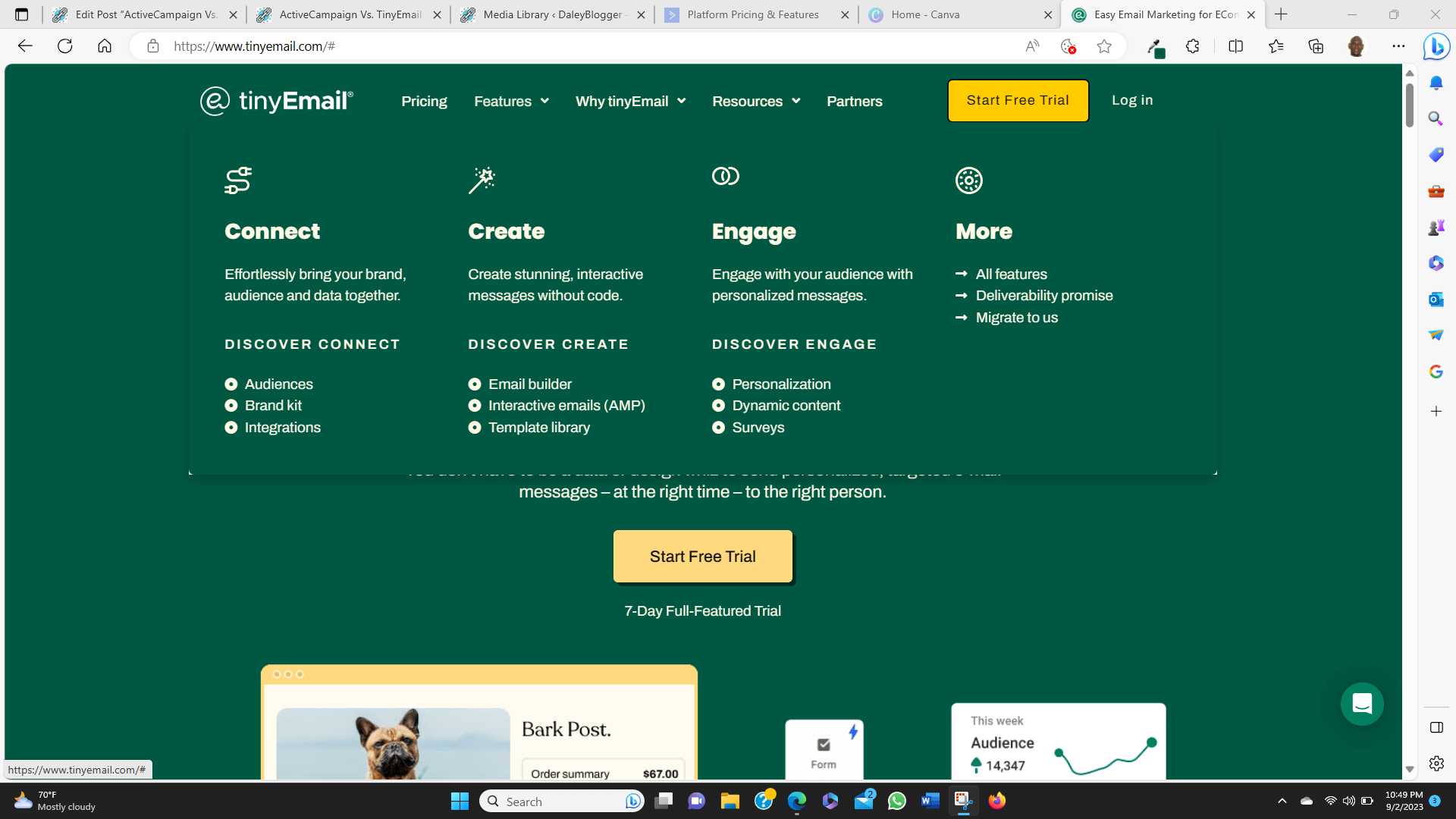
By giving an overview of ActiveCampaign and TinyEmail, this section aims to set the stage for the more detailed comparison that follows.
As we delve deeper into the functionalities, pricing, and other aspects, you’ll get a clearer understanding of how ActiveCampaign Vs. TinyEmail might affect your business decision.
Pricing – ActiveCampaign Vs. TinyEmail
One of the critical factors that most people consider when comparing ActiveCampaign Vs. TinyEmail is pricing. Both platforms offer a range of pricing options to cater to various business needs, but there are distinct differences that could influence your decision.
ActiveCampaign
ActiveCampaign offers a tiered pricing structure that caters to different business sizes and needs. The platform provides four plans: Lite, Plus, Professional, and Enterprise. Prices start at $9 per month for the Lite plan, which includes basic email marketing features and unlimited sending. As you move up the tiers, additional functionalities like automation, CRM, and advanced analytics become available, but at a higher cost.
However, I recommend that you try ActiveCampaign for free, and then decide after you have used it!

TinyEmail
TinyEmail, on the other hand, prides itself on simplicity and affordability. Its pricing model is straightforward, with a flat monthly fee based on the number of subscribers you have.
Prices start as low as $5 per month for up to 500 subscribers. This makes it an attractive option for smaller businesses or individuals just getting started with email marketing.

Free Trials and Money-Back Guarantees
Both ActiveCampaign and TinyEmail offer free trials, allowing you to test their platforms before making a financial commitment. ActiveCampaign provides a 14-day free trial, while TinyEmail offers a 7-day trial period. It’s a good idea to take advantage of these free trials to get hands-on experience with each service.
By understanding the pricing structures of ActiveCampaign and TinyEmail, you can make a more informed decision tailored to your business needs and budget constraints. As we continue to compare ActiveCampaign Vs. TinyEmail across different categories, this information will serve as a foundation for your ultimate choice.
ActiveCampaign Vs. TinyEmail – Ease of Use
When considering ActiveCampaign Vs. TinyEmail, ease of use is a crucial factor for many users. Whether you’re a seasoned marketer or new to the email marketing game, you’ll want a platform that’s intuitive and user-friendly. Let’s look at how both services fare in this regard.
ActiveCampaign
ActiveCampaign offers a robust set of features, but it also manages to maintain a relatively user-friendly interface. The dashboard is well-organized, making it easy to navigate through email campaigns, automations, and customer data. However, because it offers many advanced features like CRM and complex automations, there may be a slight learning curve for beginners.
TinyEmail
TinyEmail is designed with simplicity in mind. The platform aims to make email marketing as straightforward as possible, and its user interface reflects that. With fewer advanced features compared to ActiveCampaign, TinyEmail offers a shorter learning curve. The dashboard and features are laid out in a way that even someone new to email marketing can quickly understand.
Mobile Accessibility
Both ActiveCampaign and TinyEmail offer mobile accessibility, enabling you to manage your campaigns on the go. However, the level of functionality might differ, with ActiveCampaign offering a more comprehensive mobile experience due to its broader feature set.
In summary, while both platforms offer user-friendly experiences, they cater to different levels of expertise. ActiveCampaign provides a more comprehensive set of tools, which may require some time to master fully. In contrast, TinyEmail focuses on making the process as simple as possible, making it an excellent choice for email marketing beginners. Understanding the ease of use for both can significantly influence your decision in the ActiveCampaign Vs. TinyEmail debate.
Email Templates
A strong email marketing campaign is as much about the message as it is about the presentation.
Therefore, when comparing ActiveCampaign Vs. TinyEmail, one cannot overlook the variety and quality of email templates offered.
Let’s delve into how each platform measures up in this respect. The templates and designs we use in email marketing are crucial to our success.
ActiveCampaign
ActiveCampaign offers a wide variety of professionally designed email templates that cater to multiple industries and use-cases. Whether you’re looking to send a newsletter, promotional offers, or transactional emails, you’ll likely find a template that fits your needs. Most templates are customizable, allowing you to adjust colors, fonts, and layouts to better align with your brand.
TinyEmail
TinyEmail offers a more modest selection of templates but focuses on ease of use and quick customization. The templates are straightforward and optimized for readability across devices. Though you may find fewer industry-specific templates, what is available is clean, functional, and easy to modify.
Customization Tools
Both ActiveCampaign and TinyEmail provide template customization tools, but their capabilities vary. ActiveCampaign’s editor offers more advanced customization features like conditional content and dynamic blocks, catering to more experienced marketers. TinyEmail’s editor, on the other hand, keeps things simple with drag-and-drop functionality aimed at users who want to get the job done quickly.
In the debate of ActiveCampaign Vs. TinyEmail, the choice of email templates can be a significant deciding factor. If you’re looking for a wide variety of intricate designs, ActiveCampaign may be more up your alley. However, if simplicity and speed are your primary concerns, TinyEmail’s limited yet effective options might be more suitable.
Templates
Templates are an indispensable part of any email marketing strategy, and choosing a platform with robust template options can save you time and effort. In the comparison of ActiveCampaign Vs. TinyEmail, each service offers a distinct approach to templates, not just for emails but also for landing pages, forms, and automation flows.
Email Templates
As previously discussed, both ActiveCampaign and TinyEmail provide a variety of email templates to fit different needs. Whether you’re in eCommerce, content marketing, or a non-profit organization, these templates can act as a starting point for your campaigns.
Landing Page Templates
ActiveCampaign steps ahead when it comes to landing page templates. The platform offers a range of professionally designed landing page templates that can be customized to fit your branding. TinyEmail, depending on its latest updates, may or may not offer this feature, making ActiveCampaign a more versatile option in this area.
Form Templates
When it comes to creating forms to capture leads, both platforms offer basic form templates. ActiveCampaign allows for more advanced customization, including conditional logic and field options. TinyEmail’s forms are simpler but can be set up in minutes.
Automation Templates
ActiveCampaign has a distinct advantage in the area of automation templates. They provide a multitude of pre-made automation workflows that can be tailored to specific business goals, such as cart abandonment sequences or customer onboarding. TinyEmail, on the other hand, offers basic automation templates for simpler email sequences.
In the ActiveCampaign Vs. TinyEmail debate, templates can play a significant role in your decision-making process. If you’re looking for a platform that offers an extensive range of templates for various aspects of digital marketing, ActiveCampaign is the better choice. However, if you’re focused solely on email marketing and prefer a straightforward, no-frills approach, TinyEmail has you covered.
Automation Features
Automation is a game-changer in email marketing. It not only saves time but also helps to send the right message to the right person at the right time. When looking at ActiveCampaign Vs. TinyEmail, automation features are one of the most significant areas where these two platforms differ.
ActiveCampaign
ActiveCampaign stands out for its advanced automation capabilities. You can create complex, multi-step automations based on triggers like email opens, website visits, or even custom events. The platform provides pre-built automation recipes to make it easier to set up common sequences like welcome series, cart abandonment emails, and customer retargeting campaigns. You can even integrate the automation with ActiveCampaign’s built-in CRM to create a unified customer experience.
TinyEmail
TinyEmail offers more straightforward automation features. While it doesn’t support complex multi-step automations, you can still set up basic autoresponders and follow-up emails based on triggers like sign-ups and email opens. If your needs are simple, TinyEmail’s automation features might be sufficient.
Comparing Flexibility and Complexity
When it comes to flexibility and complexity, ActiveCampaign clearly has the upper hand. It offers a wide range of triggers, actions, and conditions that allow you to create highly tailored customer journeys. TinyEmail, on the other hand, offers fewer options but compensates with ease of use.
To sum it up, the decision between ActiveCampaign Vs. TinyEmail in terms of automation will largely depend on your specific needs. If you require advanced automation features and are willing to invest time in setting up complex sequences, ActiveCampaign is the way to go. On the flip side, if you are new to email marketing or have simpler needs, TinyEmail’s basic but effective automation options could be just what you’re looking for.
List Management
ActiveCampaign Vs. TinyEmail also presents a stark contrast when it comes to list management. The way you can segment and manage your email lists has a profound impact on the success of your email marketing campaigns. Both platforms offer list management features, but they do so in different ways.
ActiveCampaign
ActiveCampaign offers highly granular list segmentation based on a multitude of variables, such as past interactions, email opens, geographic location, and even custom fields. You can also use tags to further categorize and manage your subscribers. This level of detail allows for highly targeted email campaigns.
TinyEmail
TinyEmail, on the other hand, takes a more straightforward approach to list management. While it may not offer as many segmentation options as ActiveCampaign, it does provide basic features like list importing, exporting, and basic categorization based on user interaction with emails. Its interface is generally easier to navigate for those who are new to list management.
Bulk Actions
Both platforms allow for bulk actions, like adding or removing subscribers from specific lists or segments. However, ActiveCampaign offers more advanced bulk actions that can tie into your automated campaigns, providing a more unified approach to list management.
In conclusion, the difference in list management capabilities could be a deciding factor in the ActiveCampaign Vs. TinyEmail debate. ActiveCampaign is ideal for those who need detailed segmentation and advanced features, while TinyEmail is more suited for users who prefer a simpler, more straightforward list management solution
Customization and Personalization
ActiveCampaign Vs. TinyEmail serves as an interesting lens to examine customization and personalization options, features that can significantly impact the success of your email marketing campaigns. Both platforms offer a range of options, but they cater to different needs and levels of expertise.
ActiveCampaign
ActiveCampaign takes customization and personalization to the next level. With its dynamic content feature, you can send tailored messages to different segments within the same email campaign. You can also use advanced logic to display certain content blocks based on subscriber behavior or predefined conditions. These features can be particularly useful for businesses with diverse customer bases.
TinyEmail
TinyEmail, while not as advanced as ActiveCampaign in this domain, still offers essential customization options. You can personalize email subject lines and body content using simple tags that pull from your subscriber data. These capabilities are adequate for businesses that are looking for basic customization without too much complexity.
Ease of Use
In terms of ease of use, TinyEmail takes the cake. Its user interface for customization and personalization is simpler and more straightforward, making it easier for those who are not as technically inclined. ActiveCampaign, while robust, might have a steeper learning curve because of its advanced features.
To sum it up, the choice between ActiveCampaign Vs. TinyEmail will largely depend on how much customization and personalization you require. ActiveCampaign is ideal for businesses that need advanced personalization, while TinyEmail is more suitable for those who want to stick with the basics but get them done efficiently.
Analytics and Reporting
ActiveCampaign Vs. TinyEmail offers different degrees of sophistication when it comes to analytics and reporting. Understanding the performance of your email marketing campaigns is crucial for making data-driven decisions, and both platforms offer tools to help you do just that.
ActiveCampaign
ActiveCampaign provides comprehensive analytics and reporting features, including but not limited to, email open rates, click-through rates, conversion rates, and geolocation data. One standout feature is its customer journey mapping, which allows you to visualize how different segments of your audience engage with your content over time. This can be particularly useful for fine-tuning your future marketing strategies.
TinyEmail
TinyEmail’s analytics and reporting are more basic. However, they still cover essential metrics such as email open rates, click rates, and bounce rates. While it might not offer the deep dive that ActiveCampaign does, TinyEmail’s analytics are presented in an easy-to-understand manner, making it suitable for beginners or small businesses with straightforward needs.
Real-Time Tracking
Both ActiveCampaign and TinyEmail offer real-time tracking features, letting you see how your campaigns are performing as they unfold. However, ActiveCampaign’s real-time analytics are more advanced, providing more granular data for immediate action.
To conclude, your choice between ActiveCampaign Vs. TinyEmail in the realm of analytics and reporting will depend on your specific needs. If you require in-depth analytics and multiple reporting features to fine-tune your strategies, ActiveCampaign is a better fit. However, if you’re looking for straightforward analytics presented in a user-friendly format, TinyEmail might be more up your alley.
Integrations
ActiveCampaign Vs. TinyEmail: the integrations offered by each platform can be a pivotal factor in your decision-making process. Both platforms offer various integrations with third-party apps and services, but the scope and ease of these integrations can vary. Here’s what you need to know.
ActiveCampaign
ActiveCampaign boasts an extensive range of integrations, including but not limited to CRM systems, e-commerce platforms, social media networks, and even custom APIs. This wide array of integrations allows for a seamless workflow, enabling you to connect multiple tools and services easily. For businesses with diverse and complicated needs, the integrative prowess of ActiveCampaign can be a major advantage.
TinyEmail
TinyEmail offers a more modest selection of integrations. It covers essential services like Google Analytics, Shopify, and a handful of CRM systems. While not as extensive as ActiveCampaign, its integrations are generally easier to set up and manage, making it a suitable choice for small businesses or those with simpler needs.
Compatibility
Another point to consider is compatibility with your existing tools. ActiveCampaign’s wide range of integrations is more likely to include niche or specialized tools, while TinyEmail focuses more on universally used services.
To sum it up, if you’re in the ActiveCampaign Vs. TinyEmail debate and integrations are a key concern, you’ll find a more comprehensive set with ActiveCampaign. However, if you’re looking for essential integrations that are quick to set up, TinyEmail could be more to your liking
Deliverability Rates
When discussing ActiveCampaign Vs. TinyEmail, it’s essential to consider the deliverability rates offered by each platform. Deliverability rates measure the percentage of your emails that actually reach your subscribers’ inboxes rather than landing in spam or getting blocked. Both ActiveCampaign and TinyEmail have features to enhance deliverability, but there are some differences to note.
ActiveCampaign
ActiveCampaign has a solid reputation for high deliverability rates. They employ a range of features like domain authentication, spam filter testing, and ongoing monitoring to ensure that your emails land in the inbox. ActiveCampaign’s strong focus on compliance with regulations like GDPR also plays a role in its high deliverability.
TinyEmail
TinyEmail also performs well in the deliverability department but offers fewer advanced features. It covers the basics like SPF and DKIM authentication, which are essential for decent deliverability. However, it lacks more advanced features like spam filter testing that ActiveCampaign offers.
Comparison
Both platforms generally offer reliable deliverability, but ActiveCampaign goes above and beyond with additional features designed to maximize your email performance. If you are sending high volumes of email or targeting diverse markets with different spam filters, ActiveCampaign’s advanced features could be beneficial.
In summary, the deliverability rates between ActiveCampaign Vs. TinyEmail are both strong, but ActiveCampaign offers additional features for those who require a more robust solution
Customer Support
When evaluating ActiveCampaign Vs. TinyEmail, customer support can be a key differentiator. Both platforms offer various channels for support, but their availability and scope differ. Here’s what you can expect.
ActiveCampaign
ActiveCampaign provides a comprehensive suite of customer support options. These range from 24/7 live chat and email support to a detailed knowledge base, webinars, and even one-on-one training sessions. Their customer support is available in multiple languages, making it accessible to a global audience.
TinyEmail
TinyEmail offers a more basic but still effective set of support options. You can reach out to their team via email, and they offer a decent FAQ section for quick queries. However, they lack the 24/7 support and extensive educational resources that ActiveCampaign provides.
Response Time
Both platforms are generally responsive, but ActiveCampaign, with its 24/7 live chat, can offer immediate assistance, which can be invaluable in urgent situations. On the other hand, TinyEmail may have slower response times, especially during non-business hours.
In summary, if customer support is a critical factor in your choice between ActiveCampaign Vs. TinyEmail, ActiveCampaign has the edge with more comprehensive and timely support options.
Scalability
When it comes to ActiveCampaign Vs. TinyEmail, scalability is often a crucial factor that can influence your choice. As your business grows, your email marketing needs will evolve, and you’ll require a platform that can scale along with you. Let’s delve into how each of these platforms performs on the scalability front.
ActiveCampaign
ActiveCampaign offers a tiered pricing structure and a plethora of features designed to grow with your business. Whether you’re running a small business or an enterprise, ActiveCampaign has plans and customization options to fit your specific needs. Its robust automation features, analytics, and extensive integrations make it an ideal choice for businesses planning significant growth.
TinyEmail
TinyEmail also provides scalability but in a more straightforward manner. It offers fewer features and integrations but makes it easy to upgrade your plan as your subscriber count grows. It’s a solid choice for small businesses that expect moderate growth and have simpler marketing automation needs.
Flexibility and Future-proofing
ActiveCampaign provides more flexibility when it comes to future-proofing your business. Its extensive features and customization options mean you’re less likely to outgrow the platform. TinyEmail, while easier to use, may lack some advanced features that growing enterprises may eventually require.
In conclusion, if scalability is a significant factor in your ActiveCampaign Vs. TinyEmail decision, ActiveCampaign offers a more comprehensive set of features designed to accommodate growth, whereas TinyEmail provides a simpler, more straightforward path to scaling your operations
User Reviews and Testimonials
When examining ActiveCampaign Vs. TinyEmail, it’s crucial not to overlook what actual users have to say. User reviews and testimonials can provide invaluable insights into the day-to-day usability, customer support, and overall effectiveness of each platform. Here’s a breakdown.
ActiveCampaign
ActiveCampaign generally receives positive reviews for its robust feature set, high deliverability rates, and exceptional customer support. Users often mention how the platform has helped them automate complex email marketing campaigns efficiently. However, there are some complaints about the learning curve involved in mastering all of its features.
TinyEmail
TinyEmail, on the other hand, is often lauded for its user-friendly interface and simplicity. Its ease of use makes it a popular choice for small businesses or those new to email marketing. However, it also faces criticisms for limited advanced features and fewer integrations compared to ActiveCampaign.
Objective Metrics
While subjective experiences can be helpful, it’s also worth looking at objective metrics like customer satisfaction scores or Net Promoter Scores (NPS) if available. These can give you a more standardized view of what to expect from each platform.
To sum up, if user reviews and testimonials are a significant factor in your comparison of ActiveCampaign Vs. TinyEmail, you’ll find that both have their strengths and weaknesses. ActiveCampaign excels in features and support but may have a steeper learning curve, while TinyEmail shines in ease of use but may lack in advanced functionalities
Pros and Cons Summary
In any comparison like ActiveCampaign Vs. TinyEmail, it’s helpful to have a summarized list of pros and cons to assist in decision-making. Based on our previous discussions on features, scalability, user reviews, and other factors, here is a concise summary of each platform’s strengths and weaknesses.
ActiveCampaign Pros and Cons
Pros:
- Comprehensive feature set including advanced automation and analytics.
- High deliverability rates.
- Extensive customer support options.
- Scales easily with your business.
Cons:
- Steeper learning curve for beginners.
- May be expensive for small businesses on a budget.
TinyEmail Pros and Cons
Pros:
- User-friendly interface is ideal for beginners.
- Cost-effective pricing.
- Sufficient basic features for straightforward email marketing campaigns.
Cons:
- Limited advanced features and integrations.
- Less comprehensive customer support.
- May not be ideal for large-scale or complex marketing operations.
In conclusion, both ActiveCampaign and TinyEmail have their merits and drawbacks. Your choice between ActiveCampaign Vs. TinyEmail will likely depend on your specific needs, budget, and how much time you can invest in learning the platform.
Final Thoughts and Recommendations
After thoroughly comparing ActiveCampaign Vs. TinyEmail across multiple dimensions—from features and pricing to customer support and user reviews—it’s evident that each platform has its unique strengths and limitations. Your final choice should be guided by your business’s specific requirements. Here are some tailored recommendations:
For Small Businesses or Beginners
If you are just starting out or running a small business with straightforward email marketing needs, TinyEmail might be the better option. Its user-friendly interface and cost-effectiveness make it easy to get started.
For Medium to Large Businesses
ActiveCampaign’s extensive feature set and scalability make it more suited for medium to large businesses that require complex email marketing solutions.
For Advanced Automation
If automation is a priority, ActiveCampaign clearly has the upper hand with its wide range of automation features.
For Cost-Conscious Users
TinyEmail is generally more affordable, especially for those who don’t need advanced functionalities.
In summary, when weighing ActiveCampaign Vs. TinyEmail, consider what aspects are most critical for your business. Both platforms offer valuable solutions for different needs and at different price points
Conclusion
The debate between ActiveCampaign Vs. TinyEmail isn’t about which platform is objectively better but rather which one is the best fit for your specific needs. Which is the best email marketing tool?
Both platforms offer a range of features designed to help you engage with your audience effectively.
While ActiveCampaign excels in advanced functionalities like automation and analytics, TinyEmail provides a more streamlined, user-friendly experience.
Our deep dive into various aspects, such as pricing, scalability, user reviews, and more, has hopefully provided you with a comprehensive view to help inform your decision.
Each platform has its pros and cons, so consider your priorities—whether it’s advanced features, ease of use, or budget constraints—before making your choice.
Thank you for reading this detailed comparison of ActiveCampaign Vs. TinyEmail. I hope this comparison between ActiveCampaign vs TinyEmail which I just looked at in detail will aid you to make a purchasing decision regarding them.
Your next step is to take advantage of free trials or demos that both platforms offer to get a firsthand experience. Happy emailing

